Stacking Drives: Combinations That Actually Work
Overdrive pedals multiply. You buy one, then another shows up, then a third one arrives in a suspiciously unmarked box, and suddenly your board has more gain stages than a Cold War spy ring has double agents. The real question isn’t which overdrive to buy. It’s which two to run at the same time.
Stacking drives is one of those guitar things that sounds complicated until you understand the one principle behind it, and then it sounds obvious, and then you spend the next three years and several hundred dollars trying every possible permutation anyway. The principle is this: the first pedal in the chain sets the character of your sound, and the second pedal amplifies that character. That’s it. Everything else is details, preferences, and the kind of forum arguments that make you wonder if anyone involved has ever actually played a gig.
Why Order Matters (More Than You Think)
Think of your signal chain like a recipe. The first drive pedal is the main ingredient. The second one is the heat. A Tube Screamer into a clean amp gives you that honky, mid-focused thing that sounds like Stevie Ray Vaughan warming up. Put a transparent overdrive after it and you’re turning up the volume on that mid-push, making it louder and more saturated without changing its fundamental flavor. Reverse the order and you get something completely different: a clean, full-range drive that’s being squeezed through the Tube Screamer’s mid hump, which thins it out and adds compression in a way that feels like playing through a smaller amp.
Same two pedals. Same settings. Opposite order. Totally different sounds. This is why your buddy’s board sounds nothing like yours even though you bought the same gear.
What “Transparent” Actually Means
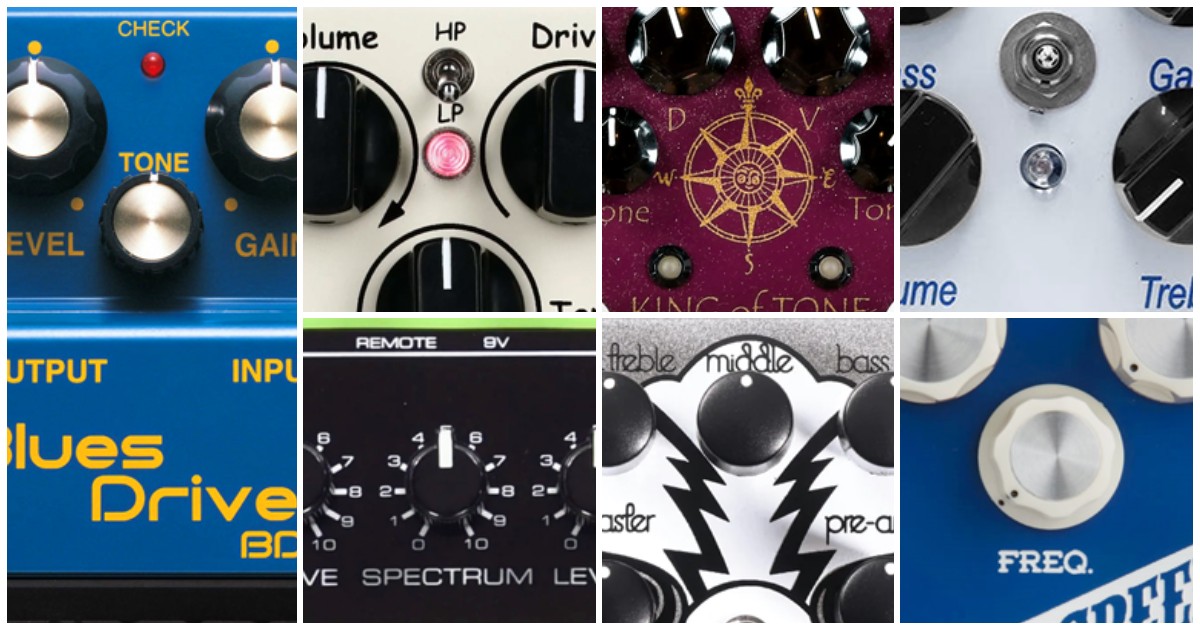
Guitarists throw the word “transparent” around like confetti at a parade nobody asked for. In the context of stacking, transparent means a pedal that adds gain without significantly reshaping your EQ curve. It makes things louder and more overdriven without imposing its own tonal opinion on the proceedings. The EHX Soul Food, the JHS Morning Glory, and the Analogman King of Tone all fall into this camp, though they each do it differently. (Several of these show up in our overdrive roundup for good reason.)
A non-transparent drive, by contrast, has a strong EQ signature. The Tube Screamer rolls off low end and boosts the upper mids. The ProCo RAT scoops the mids and adds fizzy high-end saturation. These aren’t flaws. They’re features. But when you’re stacking, you need to know which pedal is going to play nice with others and which one is going to grab the steering wheel and drive the car into a ditch.
The best stacking combinations usually pair one opinionated pedal with one transparent one. Two opinionated pedals fighting each other sounds like two people arguing at a dinner party while everyone else pretends to check their phones.
The Combinations That Work
The Classic: Tube Screamer Into a Transparent Drive
This is the Jordan-Pippen pick and roll of gain stacking. The Tube Screamer pushes your mids and compresses the signal, and the transparent drive behind it adds volume and saturation without undoing that mid-focus. The result is a fat, singing lead tone that cuts through a band mix like it has a reserved parking spot.
The TS808-into-King-of-Tone pairing has become something of a quiet standard among working guitarists, and the reason is almost boring in how logical it is. The TS808 does the shaping, the KoT in low-drive mode does the pushing, and the amp just sits there wondering what it did to deserve this much signal. Absurdly good.
If you don’t want to spend King of Tone money (or wait King of Tone wait times, which at this point could qualify you for a mortgage), the Soul Food does a similar job at a fraction of the cost. Both the Soul Food and the BD-2 made our best pedals under $100 list, and they’re both excellent stacking partners. It won’t have the same dynamic range, but for stacking purposes, it gets you eighty percent of the way there.


The Blues Lawyer Special: Blues Driver Into a Tube Screamer
Reverse the script. The Boss BD-2 has a wide, open sound with a gritty edge that responds to your picking dynamics like it’s reading your mind. Stack a Tube Screamer after it and the TS tightens up the BD-2’s loose low end, focuses the mids, and adds sustain. You go from jangly blues crunch to a focused, singing lead tone with one stomp. This is the combination that half the blues guys at every jam session are running, and there’s a reason for that: it works so well it almost feels like cheating.


The Modern Rock Workhorse: Morning Glory Into an OCD
The Morning Glory is a Marshall-flavored light drive that sounds like a cranked Bluesbreaker amp if you squint. The Fulltone OCD is a medium-gain drive with a wide EQ range and enough output to push a clean amp into breakup on its own. Stack them and you get this layered, complex drive sound where the Morning Glory provides the foundation and the OCD adds grit and volume on top. It’s particularly good for rhythm work where you want crunch that still has note definition inside chords.


The Sleeper: Plumes Into a Blues Driver
This one doesn’t get talked about enough. The EQD Plumes in its clean boost mode (Mode 2) has an open, unclipped sound that pushes your amp into natural breakup without imposing its own distortion character. Run it into a BD-2 with the gain at about nine o’clock and you get this muscular crunch that cleans up beautifully with your guitar’s volume knob. The kind of combination that makes you wonder why it isn’t more famous. Like John Cazale’s filmography, or the McRib.

The Short Version: Four Rules
-
Low gain into high gain. Always. Two heavily distorted pedals stacked together produces a compressed, fizzy mess that sounds like a bee trapped in a tin can. Keep the first pedal’s gain low-to-moderate and let the second one do the heavy lifting.
-
First pedal shapes. Second pedal pushes. The EQ character of your first drive sets the tone. The gain of your second drive sets the intensity. Treat them as two different jobs, not two of the same job.
-
Check what happens when you turn one off. A good stack gives you three usable sounds: pedal A alone, pedal B alone, and both together. If any of those three sounds bad, rethink the pairing.
-
Your amp is the third pedal. A drive stack into a clean Fender Twin behaves completely differently than the same stack into a dirty Marshall. Ignoring the amp is like ignoring the drummer. Things fall apart.
The whole appeal of stacking drives is that two good pedals can become something better than either one alone. Not louder, not more distorted, but more complete — the way a movie gets better when the casting director pairs two actors who have chemistry instead of just two actors who are famous. Find the pair that makes your amp sound like it’s finally doing what it was built to do, and then leave it alone. Or don’t. Nobody in the history of guitar pedals has ever left anything alone.