How to Compare Pedals Side by Side on PedalFilter
You’re standing in the middle of a decision between a Boss DD-8 and a TC Flashback 2, and you’ve got six browser tabs open: two Sweetwater listings, a Reverb price comparison, a Reddit thread from 2019 where someone says “just get the DD-8” and someone else says “the Flashback 2 is way better and it’s not even close,” a YouTube demo filmed in a bedroom with Christmas lights, and a forum post that somehow turned into an argument about analog versus digital delay even though neither of these pedals is analog. You still don’t know which one is smaller. You still don’t know if they both run on standard 9-volt power. You’ve been at this for forty-five minutes and you’re further from a decision than when you started.
I built the compare feature because that’s where I kept ending up too.
The Basic Idea
PedalFilter lets you select any pedals in the database and throw them into a side-by-side comparison table. Dimensions, power requirements, bypass type, number of controls, weight, the stuff that actually matters when you’re trying to figure out if something will fit on your board and play nice with your power supply. No opinions. No rankings. Just the specs, lined up so you can see the differences without toggling between product pages and trying to hold numbers in your head like a human spreadsheet.
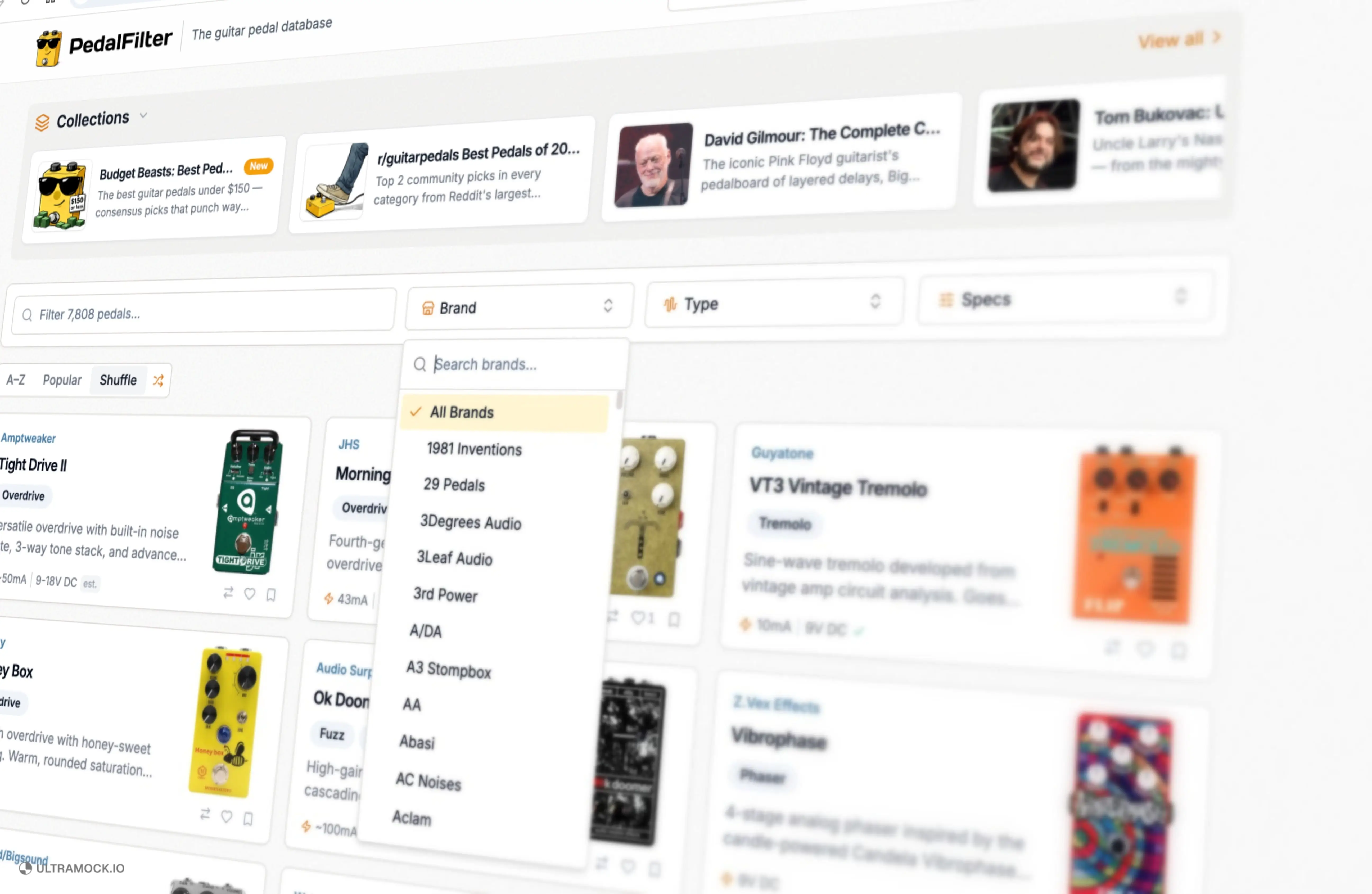
Here’s how it works. Browse or search for a pedal, and you’ll see a compare button on every card. Tap it. The pedal gets added to your compare tray. Find the next pedal, tap again. When you’ve got your candidates lined up, open the comparison and everything sits side by side in a table that scrolls if you’re on mobile and lays flat if you’re on a desktop. Simple as that.
A Real Example: The Delay Problem
Let’s say you’re choosing between the DD-8 and the Flashback 2, because this is a decision thousands of guitarists actually face. Both are digital delays in the sub-$200 range from major manufacturers, both have multiple delay modes, both have solid reputations. On paper they look almost identical, which is why people end up on Reddit arguing about them.


In the compare view, the differences show up fast. The DD-8 runs on Boss’s standard 9V/55mA draw. The Flashback 2 also runs on 9V but pulls 100mA. That matters if your power supply is already maxed out and you’re trying to squeeze one more pedal onto an isolated output. The DD-8 is Boss’s standard compact size. The Flashback 2 is slightly wider. These aren’t things you’d notice reading two separate product pages, but when they’re in the same row of the same table, the picture gets clear.
Bypass type is another one. Boss uses buffered bypass on the DD-8, which means your signal is always running through the pedal’s buffer whether the effect is on or off. The Flashback 2 gives you the option of true bypass or buffered. If you’ve got a long cable run and need buffers, Boss has you covered automatically. If you want the signal chain to pretend the pedal doesn’t exist when it’s off, TC gives you that choice. Neither approach is wrong. But knowing which one you’re getting before you buy it saves you from the very specific disappointment of discovering your new pedal is the reason your treble rolled off.
Another Example: The Overdrive Standoff
Delays are easy because the specs tend to be straightforward, but the compare feature works just as well for the messy categories. Take overdrives. Say you’re trying to decide between an Ibanez TS9 Tube Screamer and a Boss BD-2 Blues Driver. These two have been the first-overdrive-pedal debate for twenty years, and the recommendations you’ll find online are roughly 50/50, which is another way of saying useless.
The compare table shows you that the TS9 has three knobs (Drive, Tone, Level) and the BD-2 also has three (Level, Tone, Gain). Same number of controls, similar layout, similar price. So far, not helpful. But then you look at the current draw, the dimensions, the bypass type. The TS9 is true bypass. The BD-2 is buffered. If you’re already running two Boss pedals with buffers, adding a third buffer might not be what your signal chain needs. If you’ve got no buffers at all and a 20-foot cable, the BD-2’s buffer is doing you a favor.


I’m not going to tell you which overdrive to buy. I have opinions (I’d take the BD-2, the dynamic range is wider and it cleans up better with your guitar’s volume knob), but the point of the compare feature isn’t to make the decision for you. It’s to give you the information so the decision makes itself.
What This Doesn’t Do
The compare table won’t tell you which pedal sounds better. It can’t. “Better” is a word that means nothing without context, and context means your amp, your guitar, your playing style, the kind of music you make, and whether you’re playing in a bedroom or a bar. What the table does is eliminate the guesswork on the objective stuff so you can focus your energy on the subjective stuff, which is the part that actually requires your ears.
It also won’t rank pedals for you. There’s no score, no star rating, no “Editor’s Choice” badge. I’ve read enough gear reviews with mysterious scoring rubrics to last several lifetimes, and I’ve never once changed a purchasing decision based on whether something got 4.3 stars or 4.5 stars. The difference between those numbers is one reviewer’s opinion about how much they liked the shade of blue on the enclosure.
The Short Version
Find pedals. Add them to compare. Look at the table. Make a decision based on facts instead of forum arguments. (If you haven’t used the filters yet, the search guide covers everything.) That’s the whole thing. No account required, no paywall, no “sign up for our newsletter to unlock the comparison.” You’re choosing between two metal boxes with knobs. The least I can do is make the specs easy to read.
The next time you’re eight tabs deep in a delay pedal research spiral at midnight, close seven of them. You only need one.