Best Pedals Under $100 in Every Category
Here’s a thing nobody in the guitar pedal industry wants you to figure out on your own: the difference between a $90 pedal and a $300 pedal is almost never $210 worth of tone. It’s $210 worth of marketing, enclosure finish, and the warm feeling you get from telling people at the gig that your overdrive was hand-wired by a guy named Dale in Portland. Dale does good work. But your audience cannot hear Dale.
This isn’t a list of compromises. Every pedal here is something you could put on a board and play a gig with. One pick per category, all under a hundred bucks (mostly used, a few new). Fourteen categories. If I’m wrong about any of them, you’re out less than a hundred bucks, which is the cheapest tuition in all of guitardom.
Overdrive: Boss BD-2 Blues Driver (~$70 used)
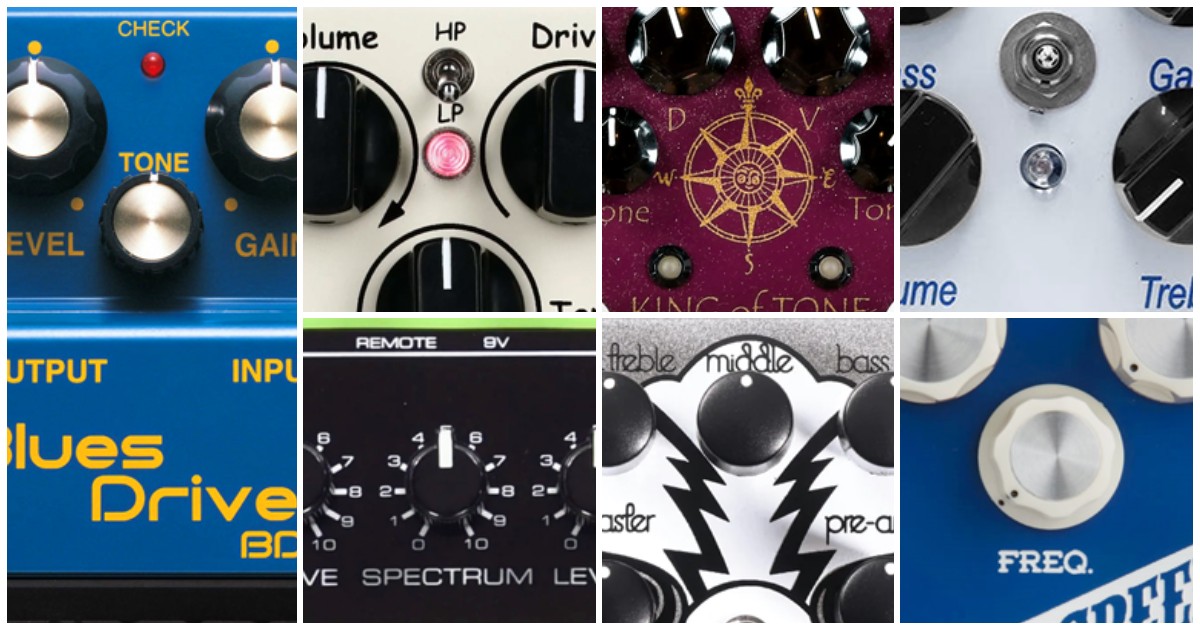
The BD-2 has been in continuous production since 1995, which in guitar pedal years makes it roughly as ancient as fire. It endures because it does something that pedals three times its price struggle with: it responds to your playing dynamics like an actual amplifier. Roll your guitar volume back and it cleans up. Dig in and it growls. The drive range goes from barely-there sparkle to a hairy crunch that sits right on the edge of distortion without tipping over, and the tone knob is one of the most musical on any pedal at any price.

The EHX Soul Food is the other obvious pick here, but the BD-2 wins on range. For a deeper look at what makes the BD-2 and six others worth the hype, see 7 overdrives that earned the hype. The Soul Food does one thing well. The BD-2 does three things well. At around $110 new, it’s technically over the line, but used BD-2s are everywhere and they’re built like tanks.
Distortion: Boss DS-1 (~$35 used)
The DS-1 is the pedal that every guitarist buys first and sells within a year, and that reputation is, frankly, half-earned. Out of the box with everything at noon, it sounds like an angry wasp stuck in a paper cup. But here’s what nobody tells the kid who just bought one at Guitar Center: turn the distortion to nine o’clock, the tone to about one o’clock, and the level up to compensate. Suddenly you’ve got a tight, focused, slightly aggressive drive that sounds less like a budget pedal and more like the first thirty seconds of “Smells Like Teen Spirit.” Kurt Cobain used a DS-1 on Nevermind. The pedal has credentials. We wrote the full DS-1 deep dive if you want the whole story.

The ProCo RAT is the other sub-$100 distortion worth your time, with a darker, fuzzier character that works better for sludgier stuff. But the DS-1 is cheaper, smaller, and available at every music store on Earth, which counts for something.
Fuzz: EHX Big Muff Pi (~$90 new)
The Big Muff has been cloned, modded, rehoused, and reissued so many times that tracking its lineage requires the kind of genealogical commitment normally reserved for European monarchies and labradoodle breeders. The current big-box reissue is the one to get. It’s louder than the Nano version, the sustain knob has a wider usable range, and there’s something about the physical size of it on your board that announces your intentions before you even plug in. This is a pedal that takes up space. It earns it.

What it does: sustain for days, a scooped mid character that sounds enormous when you’re playing alone and can disappear in a band mix if you’re not careful, and a woolly, blown-out quality at high gain settings that is either the best sound in the world or the worst, depending on whether you’ve ever listened to Dinosaur Jr. on purpose. If you have, you already own one.
Delay: Boss DD-3 (~$65 used)
The DD-3 has been on more pedalboards than some tuners. It’s a digital delay that does the basic things with zero fuss: clean repeats, a usable range from slapback to long ambient trails, and a hold mode that lets you loop a phrase and play over it. The repeats are pristine and clear, which is either what you want or it isn’t, but for the price, nothing else comes close to this level of reliability and sound quality. Boss discontinued the DD-3 in favor of the DD-3T (which adds tap tempo and runs about $150 new), but the used market is flooded with originals, and they all work fine.

If you want something darker and more lo-fi, save up another forty bucks for a used Boss DM-2W. But the DD-3 is the Swiss Army knife. It does the job and it will outlive you.
Reverb: Boss RV-6 (~$100 used)
Reverb is the category where cheap pedals have historically struggled the most. The algorithms require processing power and the budget options used to sound like you were playing inside a bathroom at a Motel 6. The RV-6 changed that. Eight modes, from a subtle room that adds dimension without drowning your signal, to a shimmer mode that sounds like your guitar is ascending bodily into heaven, to a modulated reverb that adds gentle movement. The plate and hall settings are the standouts.

I’ll be honest: the RV-6 is right at the $100 line used, and $150 new. It’s the most expensive pick on this list. It’s also the one where cheaping out hurts the most. Bad reverb is worse than no reverb. The EHX Oceans 11 is the alternative if you want more modes for similar money, but I think the RV-6’s sounds are more immediately usable and less dependent on knob-tweaking to get right.
Chorus: EHX Small Clone (~$70 new)
Chorus is the most misunderstood effect in guitar. People associate it with the worst excesses of 1980s hair metal, and fair enough, some of that was rough. But a good chorus at a subtle setting adds width and dimension to a clean tone in a way that nothing else replicates. The Small Clone has one knob (Rate) and one switch (Depth). That’s it. No menus, no presets, no scrolling through fourteen parameters like you’re filing your taxes on a pedalboard. You turn the knob until it sounds good. Kurt Cobain used this one on “Come As You Are,” which is the second time Nirvana has appeared in this article, and I promise that’s a coincidence and not a thesis.

The Boss CE-2W is the classic alternative, though it usually runs above the $100 mark used. If you find one at the right price, grab it. The CE-1 mode is stunning.
Compressor: Boss CS-3 (~$55 used)
Most guitarists don’t need a compressor and won’t notice what it does. A compressor is the flossing of guitar effects: boring, invisible, and only appreciated by people who were already doing it. But if you play clean a lot (country, funk, that glassy Fender thing where every note needs to ring at the same volume), a compressor turns your guitar into a precision instrument. The CS-3 is a workhorse that’s been in Boss’s lineup since the late ’80s. It squashes your dynamics gently, adds sustain to single notes, and evens out picking inconsistencies.

The knock on the CS-3 is that it can be noisy at extreme settings, which is the knock on every budget compressor, and also on most expensive compressors. Keep the sustain knob below two o’clock and the attack above nine, and it behaves. The MXR Dyna Comp Mini is the other sub-$100 option worth considering, with a simpler two-knob layout and a slightly squishier feel.
Phaser: MXR Phase 90 (~$60 used)
The Phase 90 is one of those pedals where simplicity is the entire point. One knob. Speed. That’s it. Turn it slow for a gentle, undulating sweep that adds movement to clean chords without drawing attention to itself. Turn it fast for the Leslie-ish warble that every Van Halen fan is already hearing in their head. Eddie used a Phase 90 on the first two Van Halen records, and the sound is so embedded in classic rock DNA that most people have heard it without knowing what it was.

The circuit is simple enough that the pedal basically can’t break. MXR has been making them since 1974, and the current reissue ($100 new) is functionally identical to the ones that have been on pro pedalboards for fifty years. At $60 used, it’s a steal. The Phase 95 packs the Phase 90 and Phase 45 circuits into a mini enclosure for the same price if board space is tight.
Wah: Dunlop Cry Baby GCB95 (~$50 used)
The Cry Baby is the default wah pedal in the same way that Kleenex is the default tissue. There are fancier options. There are more adjustable options. There are options with auto-return and adjustable Q ranges and internal trimpots that let you dial in exactly the frequency sweep you want. None of them have outsold the GCB95, because the GCB95 does the thing a wah pedal needs to do, and it does it for less than a decent dinner for two.

The sweep is vocal and midrange-heavy, which is exactly what Hendrix and Clapton were going for and exactly what most people want from a wah. It’s about $100 new and $50 used, but used Cry Babys are so common that you could probably find one in any pawn shop within a ten-mile radius of wherever you’re sitting right now. The only maintenance they need is occasional pot cleaning, which is true of every wah ever made and is a five-minute job with contact cleaner.
Tremolo: Boss TR-2 (~$55 used)
Tremolo is the oldest guitar effect there is. It was built into Fender amps in the 1950s before anyone thought to put it in a pedal, and the sound is so fundamental to guitar music that it barely registers as an “effect” anymore. It’s just volume going up and down at a speed you choose. The TR-2 does this with three knobs (Rate, Depth, Wave) and no surprises. The Wave knob blends between a soft, sinusoidal pulse and a hard, square-wave chop, which gives you everything from subtle Nashville shimmer to the helicopter-blade stutter that makes “How Soon Is Now?” sound like it does.

The TR-2 has one common complaint: a slight volume drop when engaged. Some people mod it out with a resistor swap. Most people don’t notice at band volume. At $55 used, the price-to-quality ratio is hard to argue with.
Looper: TC Electronic Ditto Looper (~$55 used)
A looper is the best practice tool you can buy, and the Ditto is the best looper for people who don’t want to think about their looper. One footswitch. One knob (volume). Record, overdub, stop, clear. No menus, no built-in drums, no USB connectivity, no features that require a manual thicker than a paperback novel. You step on it, play something, step on it again, and the thing you played comes back. Then you play over it. That’s the whole pitch.

Five minutes of loop time, which is more than enough for practice and songwriting. The original Ditto has been replaced by the Ditto+ (~$130 new), but the used market is full of originals, and they do the job without any of the extra features you’d never use anyway.
Tuner: Boss TU-3 (~$60 used)
This is the most boring recommendation on the list and also the most important. If your guitar is out of tune, nothing else on your board matters. You could have a $5,000 signal chain running through a vintage Marshall into a Neve console and it would all sound terrible if your B string is ten cents sharp. The TU-3 is the industry standard stage tuner. It tracks fast, it’s visible in sunlight, and it mutes your signal while you tune so the audience doesn’t have to listen to you hunting for the note.

The TC Polytune 3 Mini is the other option, with polyphonic tuning (strum all six strings and it shows you which ones are off) in a smaller footprint. Both are about the same price used. You can’t go wrong either way. You can, and will, go wrong without a tuner.
EQ: Boss GE-7 (~$65 used)
An EQ pedal is the most underrated thing you can put on a pedalboard. It’s not exciting. It doesn’t make cool sounds. It makes your other pedals’ cool sounds work in the room you’re actually playing in. The GE-7 gives you seven frequency bands from 100Hz to 6.4kHz, each with a slider that boosts or cuts by 15dB. That’s enough to fix a muddy amp, tame a shrill overdrive, or carve out a mid-boost for solos that cuts through the band without changing your gain structure.

Think of it as the spice rack of your signal chain. Your other pedals are the ingredients. The GE-7 is the salt, pepper, and hot sauce that make them taste right in context. It’s also one of the few pedals that’s useful in the effects loop, where it can shape your amp’s tone after the preamp stage. At $65 used ($120 new), it’s the cheapest upgrade that’ll make the biggest difference to how your rig sounds in a room full of people.
Noise Gate: Boss NS-2 (~$55 used)
Nobody buys a noise gate because they’re excited about it. You buy a noise gate because your signal chain sounds like a beehive when you stop playing, and you’ve tried everything else and it’s still humming, and you’ve accepted that high-gain pedals and single-coil pickups and long cable runs and fluorescent lights have conspired to turn your rig into a white noise generator. The NS-2 is the fix. It’s been the fix since 1987.

The Threshold and Decay knobs let you set how aggressively the gate clamps down and how quickly it releases. Get it right and your signal is dead silent between notes, with no perceptible effect on your tone when you’re playing. Get it wrong and it’ll cut off your sustain like a conversation with a rude waiter. The trick is to set the threshold just above your noise floor and the decay slow enough that your notes ring out naturally. The NS-2 also has a send/return loop, so you can put your noisy pedals in the loop and gate only them. That feature alone is worth the $55.
Fourteen categories, fourteen pedals, and a total cost of about $850 if you buy everything used. That’s less than two Strymon pedals, and it covers your entire board from tuner to looper. Start here. Upgrade later, when you know what you’re upgrading from and why, because the expensive stuff sounds a lot better when you understand what it’s doing that the cheap stuff isn’t.