7 Overdrive Pedals That Actually Live Up to the Hype
There are too many overdrive pedals. The market has a hype problem: every new release gets the full YouTube treatment, sixty seconds of ambient noodling into a cranked Deluxe Reverb, someone whispering “this one’s different” into a $3,000 microphone, and suddenly there’s a nine-month waitlist. Most of them are fine. Some of them are great. A few of them actually change the way you play.
Here are seven that have earned the noise people make about them. And no, the Tube Screamer isn’t on this list. There are enough articles about the Tube Screamer to fill a landfill. You know what it does. Let’s talk about the others.
1. Boss BD-2 Blues Driver
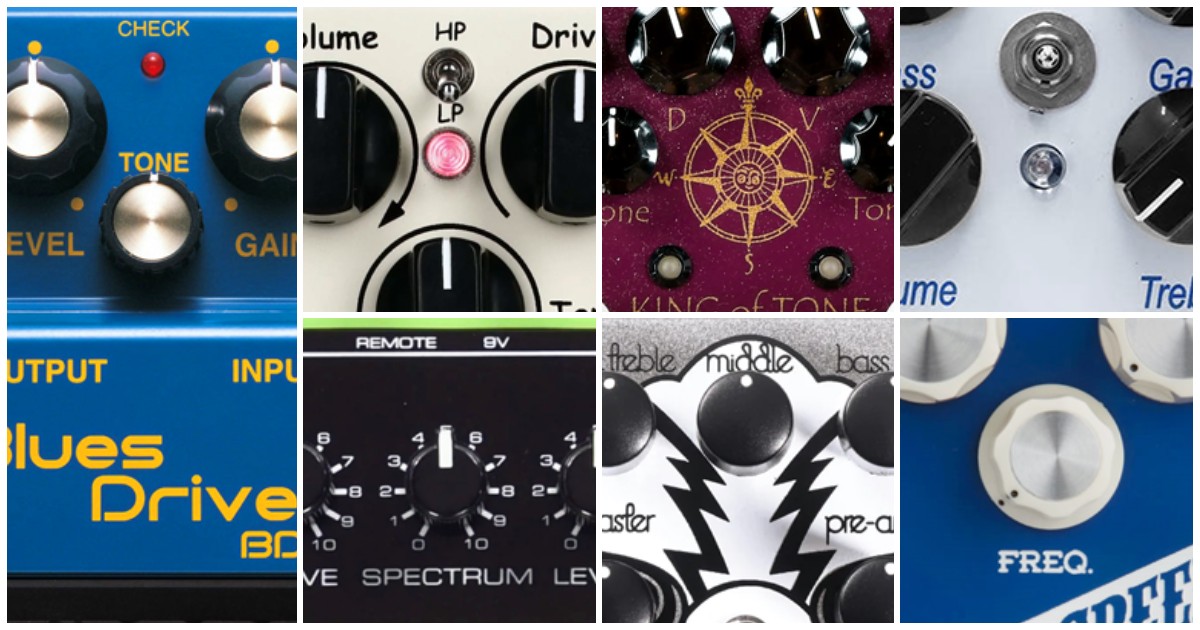
The BD-2 is the generalist that specialists keep underestimating. It does light breakup, medium crunch, and everything in between with a naturalness that makes it feel less like a pedal and more like an extension of your amp’s gain channel. The secret is in how it responds to pick attack: play softly and it stays clean, dig in and it pushes into grit, and the transition between those two states is smoother than most pedals costing three times as much.

Here’s the thing about the BD-2 that doesn’t get said enough: it costs around sixty dollars. (It also made our best pedals under $100 list, alongside its stablemate the DS-1.) New. Not on Reverb, not in a pawn shop, not “I found one in my uncle’s garage.” Sixty dollars from any guitar store on the planet. And it hangs with pedals in the $200-$300 range without breaking a sweat. That price-to-performance ratio is the kind of market inefficiency that would make a Wall Street quant weep.
2. Fulltone OCD
The OCD is the pedal that made “transparent overdrive” a selling point instead of a contradiction. In its LP (low peak) mode, it delivers a more transparent, open drive that doesn’t impose a strong EQ signature on your sound. Your guitar still sounds like your guitar, just louder and more saturated, which turns out to be exactly what most people want from an overdrive even if they don’t know how to articulate it. The HP mode has more gain and a thicker, mid-forward character with extra low-end push, more suited to players who want a British-voiced grind.

Where the OCD earns its hype is in the gain range. Most overdrives have a sweet spot that occupies maybe a quarter of the knob’s rotation. The OCD’s sweet spot is the entire knob. Every setting from barely-on to fully-cranked sounds intentional, which is a harder thing to design than it sounds. It’s the Jeff Bridges of overdrive pedals: good in everything, never phoning it in, strangely underrated despite being objectively excellent.
3. Analogman King of Tone
The KoT has a multi-year waitlist, a cult following that borders on religious, and a used-market price that keeps climbing like it’s trying to reach escape velocity. The question is whether any of that is justified or whether it’s all scarcity marketing and confirmation bias. Annoyingly, it’s justified.

The King of Tone is two overdrives in one enclosure, each side independently adjustable, and the magic is in how they interact. Run one side as a clean boost and the other as a medium drive and you’ve got a two-channel amp in a box. Run both sides simultaneously and the way they cascade into each other produces this complex, layered harmonic thing that’s genuinely difficult to replicate with two separate pedals. It’s like the sonic equivalent of that restaurant dish you keep trying to make at home but it’s never quite right because the chef has some ingredient you can’t identify. The ingredient is the circuit. And also probably butter.
4. Paul Cochrane Timmy
The Timmy is what happens when an engineer looks at the overdrive market and asks, “What if instead of boosting frequencies, we let players cut them?” Most overdrives shape your tone by pushing mids or rolling off bass. The Timmy does the opposite: it starts flat and gives you independent bass and treble cut controls, so you sculpt your sound by removing what you don’t want instead of piling on what you do. It’s a subtractive approach in an additive world, and the results are startlingly open and dynamic.

Paul Cochrane designed the original in the mid-2000s and sold them through his own small operation, building each batch by hand. The circuit became so influential that MXR eventually licensed it for a mass-produced mini version, which is either a tribute or an admission that a guy working alone in his shop had already solved the problem. The Timmy sounds like your amp on its best day, which is all any overdrive should aspire to. Most fall short. This one doesn’t.
5. Nobels ODR-1
The ODR-1 is Nashville’s worst-kept secret. Session guitarists have been quietly putting this thing on their boards for decades while the rest of the guitar world argued about Tube Screamers and Klons. It’s a German-designed overdrive with a Spectrum control that acts like a tilt EQ, shifting the frequency emphasis from bass-heavy to treble-bright across a single knob. That Spectrum knob is the ODR-1’s superpower. It lets the pedal morph from thick, round rhythm tones to cutting lead sounds without touching anything else.

The ODR-1 doesn’t clip like a Tube Screamer. It doesn’t do the Klon mid-push thing. It has its own character: a muscular, slightly compressed drive that sits in a band mix like it was born there. Country players figured this out twenty years ago. The rest of the world is catching up, and the fact that it costs about a hundred bucks makes the delay in discovery even more embarrassing.
6. Catalinbread Dirty Little Secret
Most overdrives try to sound like an amp that’s been pushed hard. The Dirty Little Secret skips the metaphor and goes straight for the source: it’s a Marshall Plexi in a box, and it’s one of the most convincing amp-in-a-box circuits anyone has built. The internal switch toggles between Super Lead and Super Bass voicings, which means you’re choosing between the Marshall that Pete Townshend destroyed and the Marshall that Lemmy made into a religion.

Catalinbread built the DLS for people who want that cranked-Marshall-at-midnight thing without actually cranking a Marshall at midnight, which in most living situations is either illegal, divorce-inducing, or both. The gain range goes from edge-of-breakup chime to full-bore classic rock saturation, and the whole thing responds to your guitar’s volume knob like a real amp does. Roll the volume back to 7 and it cleans up. Dig in and it roars. That kind of dynamic range is what separates a good drive pedal from a great one, and the DLS is a great one.
7. Greer Lightspeed
The Lightspeed is the pedal that people recommend when someone asks for “an overdrive that doesn’t sound like an overdrive.” That sounds like a contradiction, and it sort of is. What it means in practice is that the Lightspeed adds gain and harmonic richness without stamping its own personality all over your signal. It’s transparent in the way that actual transparent things are transparent: you see through it to what’s behind it. Your amp, your pickups, your fingers. The Lightspeed just makes all of that a little better.

Nick Greer designed the circuit with what he calls “organic” clipping, which uses a different approach than the standard diode clipping in most overdrives. The result is a softer, more gradual breakup that feels less like a switch being flipped and more like an amp being turned up. The Freq control shifts emphasis from bass to high-mids, giving it more tonal range than the two-knob simplicity suggests. At $170 it’s not cheap, but it’s the kind of pedal that makes everything else on your board sound better, and that’s a hard thing to put a price on.
Seven overdrives, not a Tube Screamer among them, and seven different philosophies about what a guitar should sound like when you push it past polite. If you want to see what happens when you pair two of them together, read how to stack them. And you can browse all overdrives on PedalFilter to find more. The honest truth is that any one of these would serve most players for years. The slightly less honest truth is that knowing that has never stopped anyone from buying the next one. Overdrive pedals are the potato chips of the guitar world: nobody stops at one, everybody claims they’re going to, and the bag is always bigger than you think.