5 Pedals You've Never Heard Of (But Should)
Every guitarist has the same origin story. You buy a Tube Screamer, then a Big Muff, then something from Strymon that costs more than your first guitar, and then you spend three years on forums arguing about whether analog delay is “better” than digital with people you’ll never meet. It’s a beautiful system. It keeps the economy moving.
But somewhere between the pedals everyone recommends and the pedals nobody can afford, there’s a middle ground full of weird, brilliant, criminally overlooked stuff from builders who aren’t spending money on Super Bowl ads. These are five of them. I’m not going to call them “hidden gems” because that phrase makes me want to lie down, but they are pedals that deserve more attention than they’re getting.
1. Caroline Hawaiian Pizza
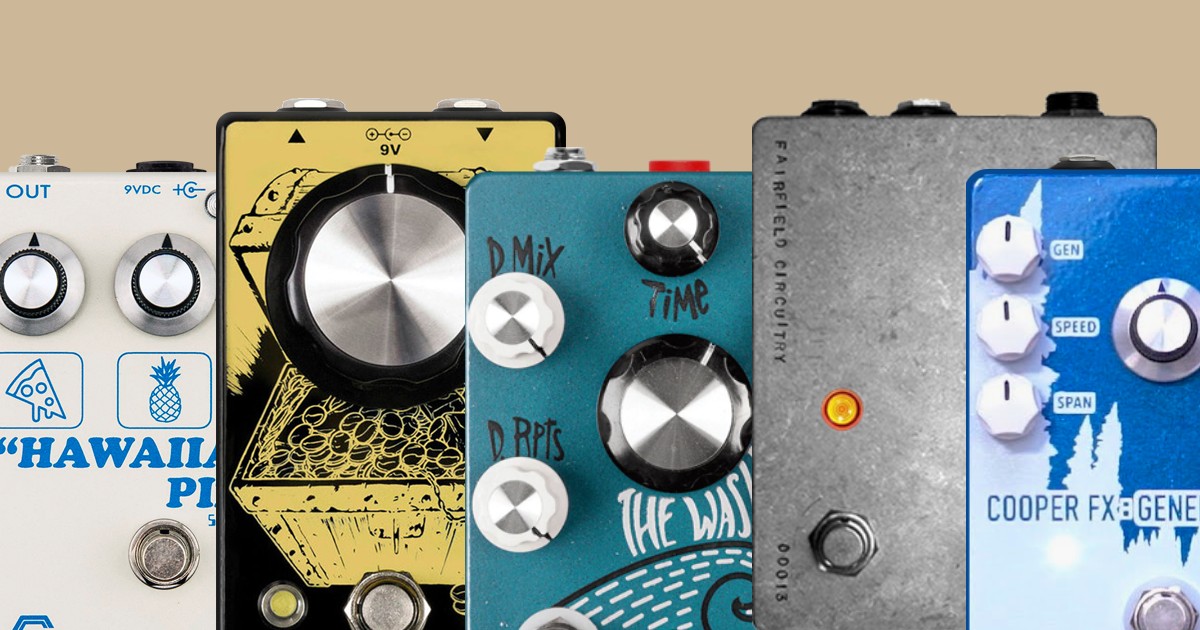
The name is a provocation, and that’s the point. Caroline Guitar Company named their fuzz pedal after the most divisive food on Earth because the pedal itself is divisive. It’s a fuzz built around a pair of silicon transistors that sounds like someone put a vintage Fuzz Face in a blender with a broken AM radio, poured the result into a metal enclosure, and silk-screened a pineapple on it.

What makes the Hawaiian Pizza interesting is how its three controls — Pig, Pineapple, and Pizza — interact to push the fuzz from gritty and gated to completely unhinged. With everything dialed back, you get a surprisingly usable fuzz that cleans up well with the volume knob. Crank the controls and you get the sound of a guitar amp falling down a flight of stairs in a way that somehow still works in a band context. Caroline builds pedals for people who are bored by safe choices, and the Hawaiian Pizza is the most Caroline pedal Caroline has ever made. I think that deserves some respect.
2. EarthQuaker Acapulco Gold
The Acapulco Gold has one knob. Volume. That’s it. It’s a power amp distortion based on the Sunn Model T amplifier, which was the amp of choice for doom metal bands, stoner rock outfits, and anyone who wanted their chest cavity to vibrate. EarthQuaker took that circuit, shrank it down to a standard pedal enclosure, and gave you no control over the gain. The gain is all the way up. Always.

This sounds like a limitation, and I suppose it is. It’s also a kind of liberation. You plug in, you turn the volume knob to wherever you want it, and you play. No tweaking, no second-guessing, no spending forty-five minutes adjusting the drive at 2 o’clock versus 2:15 while your bandmates check their phones and question their life choices. The Acapulco Gold sounds huge. Thick, saturated, full of harmonic overtones that pile on top of each other like a crowd trying to get through a single door. It doesn’t do subtle. It does “the amp is on fire and I’m okay with it.” If that’s your thing, nothing else comes close.
3. Hungry Robot The Wash
The Wash is a delay-and-reverb pedal from Hungry Robot, a small builder out of Iowa who makes pedals that look like someone designed them while listening to Radiohead at 2 AM. Which, honestly, might be exactly what happened. The Wash combines an analog-voiced delay with a reverb wash that blooms out of the repeats, and the interaction between the two effects is where the magic lives.

Turn the delay up and the mix knob back, and you get a washy, ambient pad that sits behind your playing like fog. Push the repeats and let them scatter into reverb, and you get this dreamy disintegration where each echo dissolves into the next. Turn everything up and you’re in soundtrack territory, the kind of stuff that plays over the final scene of an indie movie where the protagonist stares out a window and learns something about themselves. It’s the rare ambient pedal that has an actual point of view, a personality beyond “make everything sound like a cathedral.” The kind of pedal that makes people in the room say “what is that?” Which is the best review a pedal can get.
4. Fairfield Circuitry The Barbershop
Fairfield Circuitry is a Canadian company that makes pedals with the visual design sensibility of a Cold War-era instruction manual, and every single one of them sounds incredible. The Barbershop is their overdrive, and it might be the most transparent overdrive on the market that still manages to have a personality. Most transparent overdrives sound like your amp, but louder and slightly warmer. The Barbershop sounds like your amp on its best day, the day all the tubes are perfectly heated and the power is steady and the room sounds right.

It can run on up to 18 volts, which gives it headroom that you can feel in the way the notes open up when you dig in. The controls are Volume, Drive, and SAG, which starves the voltage to the circuit and lets you go from clean and open to compressed and gritty. It’s not going to blow your hair back. It’s going to make you play better, which is a rarer and more valuable trick. I think every guitarist should own one transparent overdrive that stays on for the entire set, and the Barbershop belongs on the short list of pedals that can do that job without anyone in the audience knowing it’s there.
5. Cooper FX Generation Loss
The Generation Loss is a lo-fi pedal that simulates the sound of a dying VHS tape, and that description makes it sound like a novelty. It is not a novelty. It’s one of the most musical effects pedals made in the last decade, and the fact that it achieves that by making your guitar sound worse on paper is part of what makes it brilliant.

Cooper FX built the Generation Loss around the idea that degradation is its own kind of beauty. The pedal adds wow and flutter, high-frequency rolloff, hiss, and a wobbly pitch instability that mimics what happens when you play audio through a worn-out cassette deck. At subtle settings, it adds this barely-there warble and warmth that makes your clean tone sound like it’s being played back through a tape machine in a way that’s more felt than heard. At extreme settings, it turns your guitar into a warped VHS dub of itself, all warble and haze and the pleasant nausea of something familiar going slightly wrong. The Generation Loss became so popular that Chase Bliss eventually collaborated with Cooper FX on a deluxe version, which tells you something about how far a weird idea from a small builder can travel when the execution is right.
The Point
None of these pedals will show up on a “Top 10 Pedals Every Guitarist Needs” list. They’re too weird, too specific, too much the product of someone’s particular vision to appeal to the algorithm-optimized middle of the market. That’s exactly why they’re worth your time. If you want to go deeper on the companies behind pedals like these, we wrote about 5 small builders worth knowing. The pedals everyone agrees on are fine. The pedals that make you feel something are usually the ones you have to go looking for.